German Alphabet A–Z: Letters, Pronunciation and Example Words
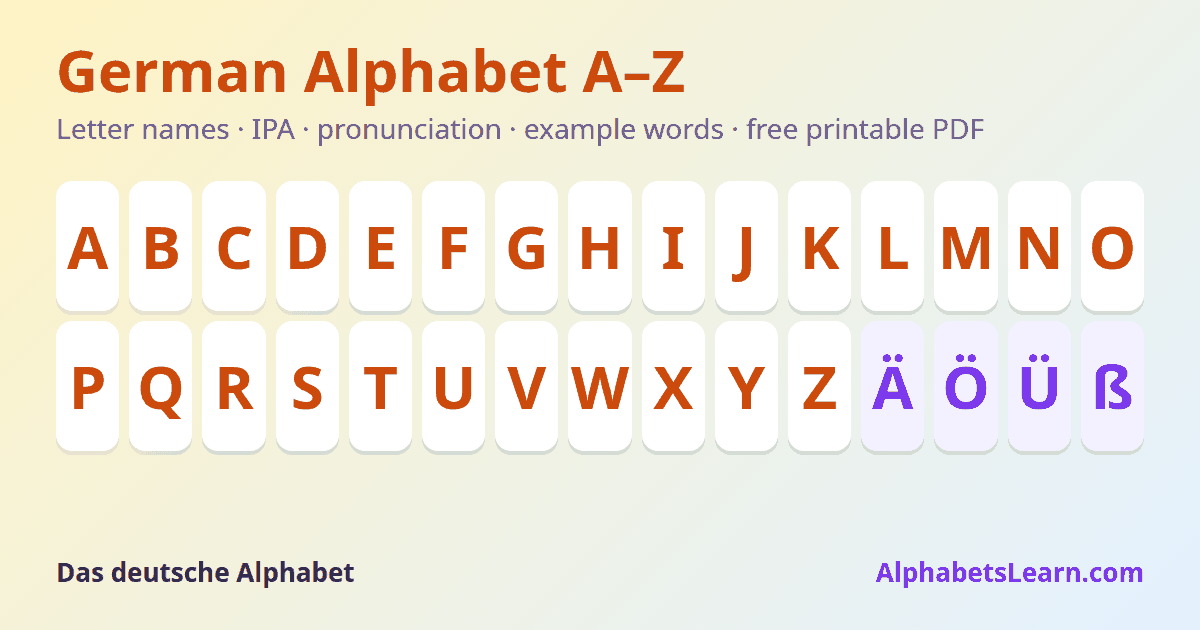
A B C … X Y Z · Ä Ö Ü ß
Quick answer: the German alphabet (das deutsche Alphabet) uses the same 26 letters as English, from A to Z. German also has three umlaut letters, Ä, Ö, Ü, and the Eszett ß ("sharp s"). These four are not part of the standard 26-letter ABC, but they are essential for reading and writing German. Many letters have different names and sounds from English. For example, W sounds like English v, V usually like f, and Z like ts.
This German pronunciation guide covers three things that beginners often mix up: what each letter is called (useful for spelling your name aloud), what sound the letter makes inside words, and how whole words are pronounced. You'll find IPA (the International Phonetic Alphabet) for accuracy, alongside simple English sound-alikes. At the end there are exercises, a quiz and a free printable German alphabet PDF.
Contents
German letters A to Z: letter names and pronunciation
These cards show the German letter names, which are how you say each letter when you spell a word aloud (buchstabieren). Each card gives the IPA for the name, an easy English guide and a common German word that starts with the letter.
- A aA [aː]"ah" as in "father"Apfel
apple - B bBe [beː]"bay"Ball
ball - C cCe [t͡seː]"tsay"Computer
computer - D dDe [deː]"day"danke
thank you - E eE [eː]"ay" (no glide)Ente
duck - F fEf [ɛf]"eff"Fisch
fish - G gGe [ɡeː]"gay" (hard g)Garten
garden - H hHa [haː]"hah"Haus
house - I iI [iː]"ee"Igel
hedgehog - J jJot [jɔt]"yot"ja
yes - K kKa [kaː]"kah"Katze
cat - L lEl [ɛl]"ell"Lampe
lamp - M mEm [ɛm]"em"Mutter
mother - N nEn [ɛn]"en"Nase
nose - O oO [oː]"oh" (no glide)Orange
orange - P pPe [peː]"pay"Pferd
horse - Q qQu [kuː]"koo"Quelle
spring, source - R rEr [ɛʁ]"air" with a throaty rrot
red - S sEs [ɛs]"ess"Sonne
sun - T tTe [teː]"tay"Tisch
table - U uU [uː]"oo" as in "moon"Uhr
clock - V vVau [faʊ̯]"fow" (rhymes with "how")Vogel
bird - W wWe [veː]"vay"Wasser
water - X xIx [ɪks]"iks"Xylofon
xylophone - Y yYpsilon [ˈʏpsilɔn]"ÜP-see-lon"Yoga
yoga - Z zZet [t͡sɛt]"tset"Zeit
time
German alphabet with pronunciation: letter sounds inside words
A letter's name and its sound are often different. The S is called "ess", but at the start of Sonne it sounds like an English z. This table shows the usual sounds in standard German, with IPA for each example word.
| Letter | Usual sound(s) | Example | IPA | Meaning |
|---|---|---|---|---|
| A | [a] short, [aː] long | Apfel | [ˈap͡fl̩] | apple |
| B | [b]; [p] at the end of a syllable | Ball | [bal] | ball |
| C | [k] or [t͡s] in loanwords; mostly in ch, ck, sch | Computer | [kɔmˈpjuːtɐ] | computer |
| D | [d]; [t] at the end of a syllable | danke | [ˈdaŋkə] | thank you |
| E | [ɛ] short, [eː] long, [ə] unstressed | Ente | [ˈɛntə] | duck |
| F | [f] | Fisch | [fɪʃ] | fish |
| G | [ɡ] (always hard); [k] at the end of a syllable | Garten | [ˈɡaʁtn̩] | garden |
| H | [h]; silent after a vowel (it makes the vowel long) | Haus | [haʊ̯s] | house |
| I | [ɪ] short, [iː] long | Igel | [ˈiːɡl̩] | hedgehog |
| J | [j] like English "y" | ja | [jaː] | yes |
| K | [k] | Katze | [ˈkat͡sə] | cat |
| L | [l] (always a clear l) | Lampe | [ˈlampə] | lamp |
| M | [m] | Mutter | [ˈmʊtɐ] | mother |
| N | [n] | Nase | [ˈnaːzə] | nose |
| O | [ɔ] short, [oː] long | Orange | [oˈʁãːʒə] | orange |
| P | [p]; pf = [p͡f] | Pferd | [p͡feːɐ̯t] | horse |
| Q | always qu = [kv] | Quelle | [ˈkvɛlə] | spring, source |
| R | [ʁ]; [ɐ] after a vowel at the end | rot | [ʁoːt] | red |
| S | [z] before a vowel, [s] elsewhere, [ʃ] in sp-, st- | Sonne | [ˈzɔnə] | sun |
| T | [t] | Tisch | [tɪʃ] | table |
| U | [ʊ] short, [uː] long | Uhr | [uːɐ̯] | clock |
| V | [f] in German words, [v] in many loanwords | Vogel | [ˈfoːɡl̩] | bird |
| W | [v] like English "v" | Wasser | [ˈvasɐ] | water |
| X | [ks] | Xylofon | [ksyloˈfoːn] | xylophone |
| Y | [yː]/[ʏ] in Greek words; [j] in English loanwords | Yoga | [ˈjoːɡa] | yoga |
| Z | [t͡s] like "ts" in "cats" | Zeit | [t͡saɪ̯t] | time |
A few notes on the examples: Orange keeps a French-style ending, and Computer and Yoga are loanwords. Native German words with C or Y are rare. You'll mostly meet C in the combinations ch, ck and sch, and Y in Greek-origin words such as Typ [tyːp] (type).
German umlauts and special characters: Ä, Ö, Ü and ß
The two dots on Ä, Ö and Ü are called an Umlaut. They change the vowel and often also the meaning: schon (already) is a different word from schön (beautiful). Umlauts often show up in plurals: Apfel → Äpfel, Bruder → Brüder.
| Letter | Name | Sound | How to say it | Example | Meaning |
|---|---|---|---|---|---|
| Ä ä | A-Umlaut [ɛː] | [ɛ], [ɛː] | like "e" in "bed" | Äpfel [ˈɛp͡fl̩] | apples |
| Ö ö | O-Umlaut [øː] | [œ], [øː] | say "ay", then round your lips like "o" | Öl [øːl] | oil |
| Ü ü | U-Umlaut [yː] | [ʏ], [yː] | say "ee", then round your lips like "oo" | über [ˈyːbɐ] | over, above |
| ß | Eszett [ɛsˈt͡sɛt] / scharfes S | [s] | a voiceless "s" as in "sun" | Straße [ˈʃtʁaːsə] | street |
- ß is not one of the 26 letters of the standard alphabet, but it is an important German character. In standard spelling it is used after a long vowel or a diphthong (Straße, Fuß, heißen), while ss follows a short vowel (Fluss, Kuss, Wasser).
- Switzerland and Liechtenstein don't use ß at all and always write ss.
- A capital ẞ exists and has been part of official spelling since 2017, but writing SS in capitals (STRASSE) is still common and correct.
- No German keyboard? Write ae, oe, ue and ss: Aepfel, Oel, ueber, Strasse.
German vowels: A, E, I, O, U, short and long
Every German vowel has a short and a long version, and the difference can change meaning. Spelling gives good clues:
- Long before one consonant (Tag), when the vowel is doubled (Boot, Meer), before a silent h (Sohn, Uhr), and in ie (Liebe).
- Short before a double consonant or a consonant group (Bett, Mutter, Fisch).
| Long | IPA | Short | IPA |
|---|---|---|---|
| Staat (state) | [ʃtaːt] | Stadt (town) | [ʃtat] |
| Miete (rent) | [ˈmiːtə] | Mitte (middle) | [ˈmɪtə] |
| Ofen (oven) | [ˈoːfn̩] | offen (open) | [ˈɔfn̩] |
| Beet (flower bed) | [beːt] | Bett (bed) | [bɛt] |
An unstressed final -e is always pronounced, as a soft "uh" [ə]: danke [ˈdaŋkə], Ente [ˈɛntə]. The ending -er sounds like a short "uh" [ɐ]: Mutter [ˈmʊtɐ].
CH, SCH, EI, IE, EU and ÄU
CH: the "ich" sound and the "ach" sound
- Ach-Laut [x], a throaty sound like Scottish "loch". It's used after a, o, u, au: Bach [bax], Buch [buːx] (book), auch [aʊ̯x] (also).
- Ich-Laut [ç], a soft hiss like the "h" in "huge". It's used after e, i, ä, ö, ü, ei, eu and after consonants: ich [ɪç] (I), Milch [mɪlç] (milk), Bücher [ˈbyːçɐ] (books).
- At the start of loanwords ch varies: Chor [koːɐ̯] (choir), Chef [ʃɛf] (boss), China [ˈçiːna], or [ˈkiːna] in southern Germany and Austria.
- The ending -ig is said [ɪç] in standard German (König [ˈkøːnɪç], king). In the south you will also hear [ɪk].
SCH, SP and ST
sch is always [ʃ], like English "sh": Schule [ˈʃuːlə] (school). At the beginning of a word or word part, sp and st are also said with "sh": Sport [ʃpɔʁt], Stein [ʃtaɪ̯n] (stone).
EI and IE
A simple trick: say the English name of the second letter. ei sounds like "eye" [aɪ̯], as in Ei (egg), drei (three) and Wein (wine). ie sounds like "ee" [iː], as in Liebe (love), Bier (beer) and vier (four).
EU and ÄU
Both sound like "oy" in "boy" [ɔʏ̯]: heute [ˈhɔʏ̯tə] (today), neu (new), Häuser [ˈhɔʏ̯zɐ] (houses).
German R, W, V, J and Z pronunciation
- R: in standard German, R at the start of a syllable is made at the back of the throat [ʁ], a little like gargling softly: rot, Rad. After a vowel at the end of a syllable it becomes a vowel-like "uh" [ɐ]: Uhr [uːɐ̯], Vater [ˈfaːtɐ]. A rolled tongue-tip R [r] is normal in parts of Bavaria, Austria and Switzerland.
- W = English v: Wasser [ˈvasɐ], Wolf [vɔlf].
- V = English f in most German words: Vogel, Vater, viel (much). It is v in many loanwords: Vase [ˈvaːzə], Klavier [klaˈviːɐ̯] (piano).
- J = English y: ja, Junge [ˈjʊŋə] (boy). It is never the "j" in "jam", except in some loanwords such as Job.
- Z = ts as in "cats", even at the start of a word: Zeit [t͡saɪ̯t], Zug [t͡suːk] (train). tz sounds the same: Katze.
Common German pronunciation mistakes for beginners
- English W and V. Wasser is "VAH-ser", not "WAH-ter". Vogel is "FOH-gel".
- English Z. Zoo is "tsoh", not "zoo".
- Swapping EI and IE. Wien (Vienna) is "veen", and Wein (wine) is "vine".
- Ignoring the umlaut. schon/schön, Mutter/Mütter (mother/mothers) and zahlen/zählen (pay/count) are different words.
- Forgetting final devoicing. At the end of a syllable, b, d and g sound like p, t and k: Hund [hʊnt] (dog), Tag [taːk] (day), gelb [ɡɛlp] (yellow).
- Dropping the final -e. danke has two syllables: "DAHN-kuh".
- Pronouncing the lengthening H. In Sohn and Uhr the h is silent. It only makes the vowel long.
- Using the "ach" sound everywhere. ich uses the soft [ç], not the throaty [x].
German alphabet practice exercises
1. Spell your name the German way
Spell your first name aloud using the German letter names. "Max" is Em – A – Ix, and "Eva" is E – Vau – A.
2. Ich or ach?
Decide whether each ch is the soft [ç] or the throaty [x]: Nacht, Licht, Kuchen, Bücher, Loch, Mädchen.
Show answers
[x]: Nacht, Kuchen, Loch (after a, u, o). [ç]: Licht, Bücher, Mädchen (after i, ü, ä).
3. Long or short vowel?
Boot, Bett, Sohn, Sonne, Liebe, Fisch
Show answers
Long: Boot (double vowel), Sohn (silent h), Liebe (ie). Short: Bett, Sonne, Fisch (double consonant or consonant group).
4. ß or ss?
Fill the gap: Stra_e, Flu_, Fu_, Wa_er
Show answers
Straße and Fuß (long vowel → ß). Fluss and Wasser (short vowel → ss).
5. Read aloud
Say these and check: Zeit, Wein, vier, heute, Straße, über.
Show answers
"tsite", "vine", "feer", "HOY-tuh", "SHTRAH-suh", "ÜE-ber" (say "ee" with rounded lips).
German alphabet quiz
Choose one answer for each question, then press Check my answers to see explanations. Your answers stay in your browser.
Answer key
1 – 26 · 2 – like English v · 3 – f · 4 – ts · 5 – "eye" · 6 – Milch · 7 – after a long vowel or diphthong · 8 – [hʊnt]
German alphabet printable PDF (free)
An A4 German alphabet guide: all 26 letters with names, IPA and easy pronunciation, example words and meanings, Ä Ö Ü and ß, the key pronunciation rules and a practice page.
📄 Download German Alphabet Printable PDFPDF · A4 · 4 pages · free for home and classroom use
Hear every German letter: tap a letter, listen, pop balloons and try the quiz.
🔤 German letters game💡 German learning tips📚 German storiesFrequently asked questions about the German alphabet
How many letters are in the German alphabet?
The standard German alphabet has 26 letters, the same as English. With the umlauts Ä, Ö, Ü and the Eszett ß, German writing uses 30 letters in total.
Is ß the same as "ss"?
Both stand for an "s" sound. ß follows long vowels and diphthongs (Straße), and ss follows short vowels (Fluss). When ß is unavailable, or in Swiss German spelling, ss is used instead.
How do you type German umlauts?
Use a German keyboard layout, long-press the vowel on a phone, or write ae, oe, ue and ss when no special characters are available.
Is German pronunciation hard for English speakers?
German spelling is much more regular than English. Once you know the rules for W, V, Z, ch and the umlauts, you can read most words correctly. The umlauts and the R take the most practice.
Why is the letter name different from the letter sound?
Letter names are what you say when spelling (S = "ess"). Inside words, the same letter can sound different. S before a vowel is [z] as in Sonne, and before p or t at the start of a word it is [ʃ] as in Sport.