Learn the Hebrew Alphabet: All 22 Letters, Sounds, Pronunciation and Example Words
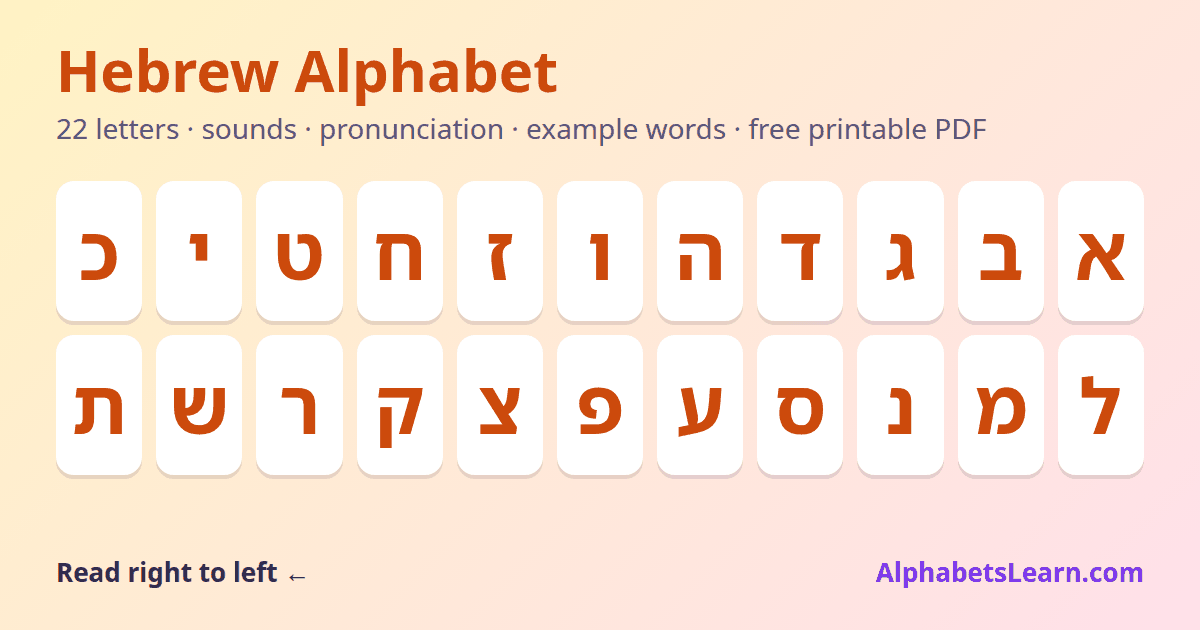
א ב ג ד ה ו ז ח ט י כ ל מ נ ס ע פ צ ק ר ש ת
Quick answer: the Hebrew alphabet (the Aleph-Bet) has 22 letters, all consonants. It is written and read from right to left. Five letters change shape at the end of a word, so you will see 27 letter shapes in total. Vowels are usually not written as letters. Instead, dots and dashes called niqqud can be added above and below the letters, mostly in children's books, poetry and learner texts.
This guide teaches the Hebrew alphabet the way most beginners actually learn it. You'll see each letter with its name, sound and a simple example word, then learn the final forms, the vowel marks and the small dot (the dagesh) that changes some sounds. At the end there are exercises, a self-marking quiz and a free printable Hebrew alphabet PDF you can keep beside you while you practise.
Contents
- What is the Hebrew Aleph-Bet?
- Why Hebrew is written right to left
- Hebrew alphabet chart: all 22 letters
- Hebrew letter sounds in English
- The five final letter forms
- Hebrew vowel marks (niqqud)
- Dagesh: the dot that changes sounds
- Pronunciation tips for beginners
- Common beginner mistakes
- Practice exercises
- Practice quiz with answers
- Hebrew alphabet printable PDF
- Frequently asked questions
What is the Hebrew Aleph-Bet?
The name Aleph-Bet (אָלֶף־בֵּית) comes from the first two letters, Aleph and Bet, in the same way the English word "alphabet" comes from the Greek letters alpha and beta. The Hebrew writing system is used for Modern Hebrew, the main language of Israel, and for Biblical and prayer-book Hebrew. The same letters are also used to write Yiddish and Ladino.
Three features make the Hebrew alphabet different from English:
- It's an abjad, a consonant alphabet. All 22 letters stand for consonants. A few of them (א ה ו י) also help show vowels. Readers fill in the remaining vowels from context, or from the optional vowel marks.
- There are no capital letters. Each letter has one printed shape, plus a special final shape for five letters.
- Printed letters don't join. Unlike Arabic, each printed Hebrew letter stands on its own. Handwritten Hebrew uses a separate cursive style whose shapes look quite different, so most learners start with the print letters shown in this guide.
The square letters used today developed from the Aramaic script more than two thousand years ago, replacing an older script now called Paleo-Hebrew.
Why Hebrew is written from right to left
Hebrew, like Arabic and Aramaic, is written from right to left. The direction was inherited from the older Semitic scripts the Hebrew alphabet grew out of. Historians have proposed reasons such as carving with a chisel in the right hand, but nobody knows for certain. For a learner, these practical points matter more:
- Start reading at the right-hand edge of the line and move left.
- Hebrew books open from what an English reader thinks of as the "back". The first page is on the right.
- Numbers and foreign words stay left to right inside Hebrew text. In יש לי 25 ספרים ("I have 25 books"), you read the words right to left but the number 25 as usual.
Try it: the word שלום (shalom, "hello / peace") begins with ש on the right and ends with ם on the left.
Hebrew alphabet chart: all 22 letters with pronunciation
Here are the Hebrew alphabet letters in order. Each card shows the letter, its name in English and in Hebrew, the sound it usually makes in Modern Israeli Hebrew, and an everyday example word with its transliteration and English meaning. Letter names have several common English spellings (Aleph/Alef, Chet/Het, Yod/Yud, Qof/Kuf, Tsadi/Tzadik). They all refer to the same letters.
- א1. Aleph אָלֶףSilent; carries a vowelאבא
abba – dad - ב2. Bet / Vet בֵּיתb with dot (בּ), v withoutבית
bayit – house - ג3. Gimel גִּימֶלg as in "go"גמל
gamal – camel - ד4. Dalet דָּלֶתd as in "dog"דג
dag – fish - ה5. He הֵאh; usually silent at the end of a wordהר
har – mountain - ו6. Vav וָוv; also the vowels o or uורד
vered – rose - ז7. Zayin זַיִןz as in "zoo"זאב
ze'ev – wolf - ח8. Chet חֵיתch as in Scottish "loch"חלב
chalav – milk - ט9. Tet טֵיתt as in "top"טוב
tov – good - י10. Yod יוֹדy as in "yes"; also the vowel iילד
yeled – boy, child - כ11. Kaf / Chaf כַּףk with dot (כּ), ch withoutכלב
kelev – dog - ל12. Lamed לָמֶדl as in "lion"לב
lev – heart - מ13. Mem מֵםm as in "moon"מים
mayim – water - נ14. Nun נוּןn as in "nest"נר
ner – candle - ס15. Samekh סָמֶךְs as in "sun"ספר
sefer – book - ע16. Ayin עַיִןUsually silent; carries a vowelעין
ayin – eye - פ17. Pe / Fe פֵּאp with dot (פּ), f withoutפרח
perach – flower - צ18. Tsadi צָדִיts as in "cats"צב
tsav – tortoise - ק19. Qof קוֹףk as in "kite"קוף
kof – monkey - ר20. Resh רֵישׁr made in the throat (like French r)ראש
rosh – head - ש21. Shin / Sin שִׁיןsh (שׁ) or s (שׂ)שמש
shemesh – sun - ת22. Tav תָּוt as in "top"תפוח
tapuach – apple
Hebrew letter sounds and their English equivalents
Most Hebrew letter sounds exist in English. The tricky part for beginners is that, in Modern Hebrew, several letters share the same sound. They were pronounced differently in the past, and the spelling kept the old distinctions. This table groups them so you know what to expect when you hear a word but don't know how to spell it.
| Sound | Letters that make it | Example | Note |
|---|---|---|---|
| silent (vowel carrier) | א ע | אם em (mother), עם am (people) | Some speakers make ע a throat sound |
| v | ב ו | ורד vered (rose) | ב without a dagesh |
| ch (as in "loch") | ח כ | חלב chalav (milk) | כ without a dagesh |
| k | כּ ק | קוף kof (monkey) | כ with a dagesh |
| t | ט ת | תפוח tapuach (apple) | Identical in Modern Hebrew |
| s | ס שׂ | ספר sefer (book) | ש with the dot on the left |
Hebrew final letters: the five final forms explained
Five Hebrew letters have a final form (סוֹפִית, sofit). It's used only when the letter is the last letter of a word. The sound stays the same. Only the shape changes. Four of the final forms stretch down below the line, and final mem closes into a box. The traditional memory word for the five letters is מנצפ״ך (menatzpach), which lists them as מ נ צ פ כ.
| Regular | Final | Name | Sound | Example word | Meaning |
|---|---|---|---|---|---|
| כ | ך | Final Kaf (Chaf sofit) | ch | מלך melech | king |
| מ | ם | Final Mem (Mem sofit) | m | שלום shalom | hello, peace |
| נ | ן | Final Nun (Nun sofit) | n | בן ben | son |
| פ | ף | Final Pe (Fe sofit) | f | כף kaf | spoon |
| צ | ץ | Final Tsadi (Tsadi sofit) | ts | עץ ets | tree |
Notice that final ך is normally read ch and final ף is normally read f in native Hebrew words. When the same root appears in the middle of a word, the regular form returns. For example, מלך (melech, king) becomes מלכה (malka, queen).
Hebrew vowel marks (Niqqud)
Because the letters are consonants, Hebrew uses optional vowel marks called niqqud (נִקּוּד, "dotting"). They're small dots and lines written mostly under the letter, and read after the consonant they belong to. You'll find niqqud in children's books, the Bible, prayer books, poetry and beginner materials. Everyday adult texts, such as newspapers, signs and messages, usually leave them out.
Modern Hebrew has just five vowel sounds: a, e, i, o, u. Several marks share each sound. In the table, each mark is shown under or beside the letter ב.
| Mark | Name | Sound | Example |
|---|---|---|---|
| בַ | Patach | a as in "father" (short) | פֶּרַח perach – flower |
| בָ | Kamatz | a (sometimes o: the rarer kamatz katan) | דָּג dag – fish |
| בֶ | Segol | e as in "bed" | יֶלֶד yeled – boy |
| בֵ | Tsere | e as in "bed" (sometimes "ey") | לֵב lev – heart |
| בִ | Hiriq | i as in "ski" | אִמָּא ima – mum |
| בֹ / בוֹ | Holam / Holam male | o as in "more" | שָׁלוֹם shalom – peace |
| בֻ / בוּ | Kubutz / Shuruk | u as in "flute" | סוּס sus – horse |
| בְ | Shva | silent, or a very short e | שְׁמוֹנֶה shmone – eight |
| חֲ | Hataf patach | short a | חֲלוֹם chalom – dream |
| אֱ | Hataf segol | short e | אֱמֶת emet – truth |
| חֳ | Hataf kamatz | short o | חֳדָשִׁים chodashim – months |
Dagesh: how a dot changes pronunciation
A dagesh is a dot placed inside a letter. In Modern Hebrew it changes the sound of only three letters, and these are the ones beginners need to know:
| With dagesh | Sound | Without | Sound | Examples |
|---|---|---|---|---|
| בּ | b | ב | v | בַּיִת bayit (house) · אָבִיב aviv (spring) |
| כּ | k | כ | ch | כֶּלֶב kelev (dog) · מֶלֶךְ melech (king) |
| פּ | p | פ | f | פֶּרַח perach (flower) · סֵפֶר sefer (book) |
- Rule of thumb for unpointed text: at the very start of a word, ב כ פ are usually b, k and p. After a vowel they are often v, ch and f.
- A dagesh can also appear in other letters (for example גּ דּ תּ). In classical Hebrew it marked doubled or harder sounds. In Modern Hebrew these letters sound the same with or without it.
- Shin and Sin use a different dot, placed on top. A dot on the right shoulder (שׁ) is sh, as in שֶׁמֶשׁ shemesh. A dot on the left shoulder (שׂ) is s, as in שִׂמְחָה simcha (joy).
How to pronounce Hebrew letters: beginner tips
- Learn the "ch" sound early. ח and כ (without dagesh) sound like the end of Scottish loch or German Bach, a soft scrape at the back of the mouth. They never sound like the "ch" in chair.
- Keep vowels pure. Hebrew o and e don't glide the way English vowels do. Say shalom with a short, clean "o", not "show-lome".
- Treat Aleph and Ayin as vowel seats. In most modern speech you simply say the vowel attached to them: אִמָּא = ima.
- Practise the Resh. The Israeli ר is made at the back of the throat, close to the French r. A rolled Spanish-style r is also understood and is used by some native speakers.
- Stress the last syllable. Most Hebrew words are stressed on the last syllable: sha-LOM, ye-la-DIM (children). Many common words break the rule, such as YE-led (boy) and SE-fer (book), so learn the stress together with each new word.
- Learn letters in small groups. Five or six letters a day, with two example words each, is a pace most beginners can keep up.
Common mistakes beginners make
- Mixing up look-alike letters. Compare them side by side:
- ב Bet has a small heel at the bottom right. כ Kaf is smoothly rounded.
- ד Dalet has a sharp corner that sticks out. ר Resh is rounded.
- ה He has a gap at the top left. ח Chet is closed at the top. ת Tav has a little foot on the left leg.
- ו Vav is a short line. ז Zayin has a flat cap. Final ן Nun drops below the line.
- ס Samekh is round. Final ם Mem is square.
- Reading left to right out of habit, especially in mixed Hebrew–English text.
- Forgetting final forms. Writing שלומ instead of שלום is a typical beginner error.
- Pronouncing every letter. א, ע and a final ה are usually silent.
- Saying English "ch". חלב is chalav with a throaty ch, never "tchalav".
- Expecting vowel marks everywhere. Practise with pointed texts first, then move gradually to unpointed ones.
Hebrew alphabet learning exercises
1. Name the letter
Say the name of each letter, then check:
ג ל צ ק ט ס
Show answers
Reading right to left: Gimel, Lamed, Tsadi, Qof, Tet, Samekh.
2. Spot the final forms
Which of these words end in a final letter?
שמש · מים · עץ · ילד · בן · כף
Show answers
מים (final mem ם), עץ (final tsadi ץ), בן (final nun ן) and כף (final pe ף). שמש and ילד end in letters that have no final form.
3. Read words with niqqud
Sound out each word, then check the transliteration:
אַבָּא · דָּג · לֵב · נֵר · סוּס
Show answers
abba (dad), dag (fish), lev (heart), ner (candle), sus (horse).
4. Look-alike sort
Sort these into pairs that are easy to confuse:
ב ד ה ר ח כ
Show answers
ב/כ (Bet/Kaf), ד/ר (Dalet/Resh), ה/ח (He/Chet).
5. Write your name
Write your first name in Hebrew letters, from right to left. Use א or ע as a seat for a vowel at the start, ו for o/u and י for i/e. Example: "Dan" = דן (with a final nun), and "Maya" = מאיה.
Hebrew alphabet practice quiz
Choose one answer for each question, then press Check my answers. Your answers stay in your browser.
Answer key
1 – 22 · 2 – right to left · 3 – א · 4 – f · 5 – ץ · 6 – sh · 7 – מים · 8 – Scottish "loch" · 9 – ב כ פ · 10 – בִ
Hebrew alphabet printable PDF (free)
A clean, A4 Hebrew alphabet chart for beginners: all 22 letters with names, pronunciation, example words, transliteration and meanings, plus the five final forms, the vowel marks, pronunciation notes and a practice page.
📄 Download Hebrew Alphabet Printable PDFPDF · A4 · 4 pages · free for home and classroom use
Hear and play with Hebrew letters: tap a letter to hear it, then pop balloons and take a quick quiz.
🔤 Hebrew letters game💡 Hebrew learning tips📚 Hebrew storiesFrequently asked questions about the Hebrew alphabet
How many letters are in the Hebrew alphabet?
The Hebrew alphabet has 22 letters. Five of them (כ מ נ פ צ) have a different shape at the end of a word, so you will see 27 letter shapes in total.
Does the Hebrew alphabet have vowels?
The letters are consonants. Vowels are shown either with optional niqqud marks (dots and lines) or with the helper letters ו and י. Most adult texts are written without niqqud.
How long does it take to learn the Hebrew alphabet?
With 15–20 minutes of practice a day, many beginners can recognise all 22 letters within one to two weeks. Reading fluently without vowel marks takes longer and comes with vocabulary.
Are there capital letters in Hebrew?
No. Hebrew has no upper case or lower case. The only change in shape is the final form of five letters at the end of a word.
What is the difference between Shin and Sin?
They are the same letter, ש. With a dot on the right (שׁ) it says "sh". With a dot on the left (שׂ) it says "s". Without niqqud you learn which one it is from the word.
Is the Hebrew alphabet the same as the Yiddish alphabet?
Yiddish is written with the same Hebrew letters, but it is a different language with its own spelling rules. For example, Yiddish writes most vowels with letters such as א and ע.
Is Hebrew handwriting different from printed letters?
Yes. Everyday handwriting uses Hebrew cursive, and several letters look quite different from their printed forms. Learn the print letters first, then learn cursive as a second step.